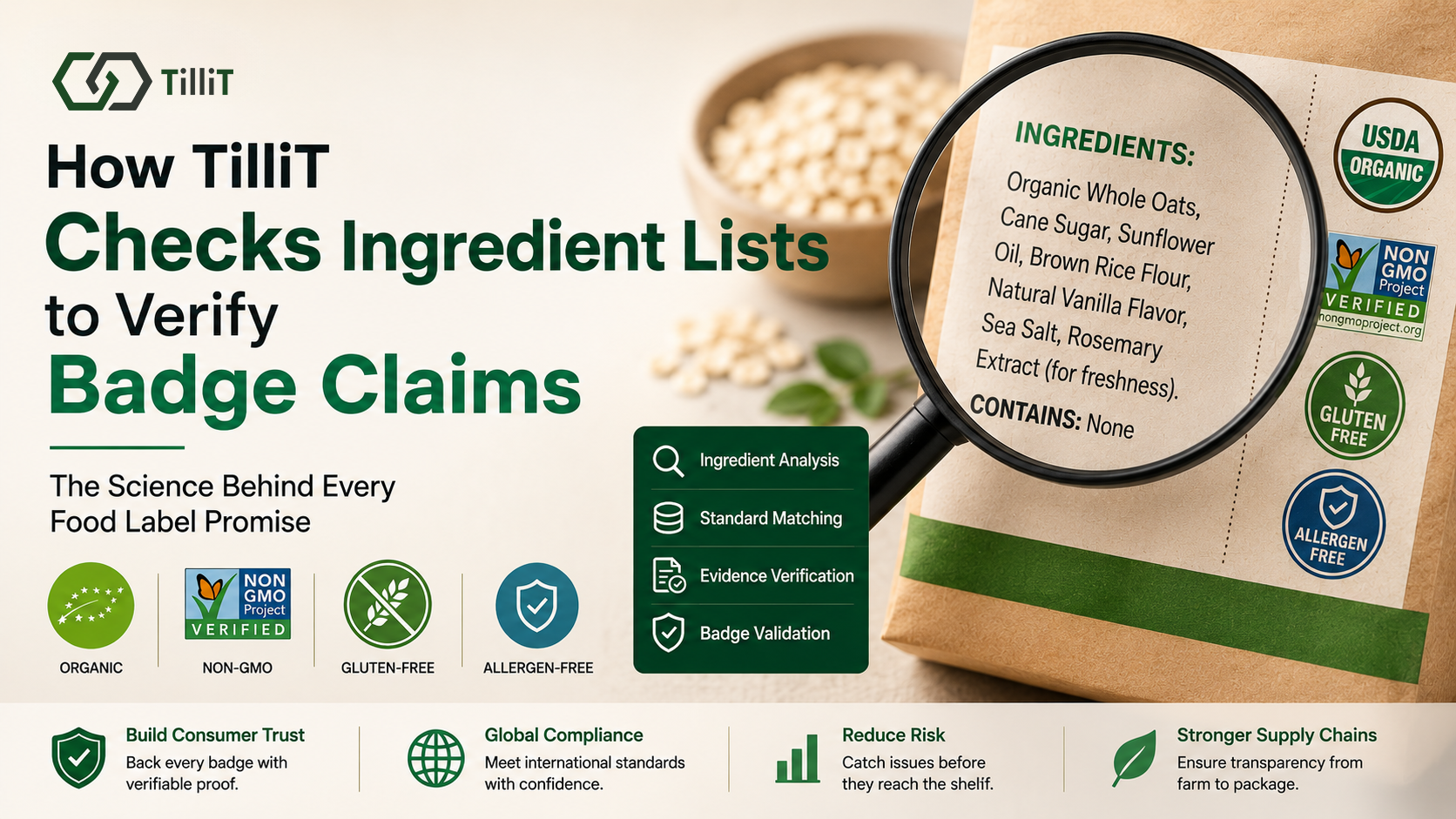
How we check an ingredient list against a claim
Originally published as “How TilliT Checks Ingredient Lists to Verify Badge Claims”
July 02, 2026
Every time a shopper picks up a packaged food item, a compact set of promises stares back from the label. A green leaf for organic, a butterfly for non-GMO, a crossed grain for gluten-free, these badges are meant to condense trust into a tiny icon. They signal that a product has been made according to strict rules: no genetically modified ingredients, no gluten above a whisper-thin threshold, none of the top allergens. But behind each badge is a web of ingredient rules, traceability data and testing requirements that must be checked, often more than once and always with unsparing rigor. For us at TilliT, that verification isnʼt a casual glance; itʼs a deep, systematic audit of every line on the ingredient list.
TilliT acts as a digital detective for food claims. It ingests ingredient data from product labels, supplier documents and certification databases, then cross-references each component against the precise standards of a badge. The result is a clear, evidence-based yes or no: does this ingredient list live up to the badge on the front of the package? In an era where nearly seven in ten consumers say they look for certifications before buying, TilliTʼs work is the quiet machinery that keeps those icons trustworthy.
The journey a badge makes from farm to label is complex. An organic cereal might source oats from Canada, sugar from Brazil and vanilla from Madagascar, each with its own certification paper trail. A gluten-free snack could be made in a facility that also handles wheat. An allegen-free claim must survive contact with sesame in a shared processing line. This article walks through four of the most demanding food badges - organic, non-GMO, gluten-free and allergen-free - and explains how TilliT checks ingredient lists to verify that the badge on the front of the package is more than just a marketing flourish.
Organic certification in the EU and Japan
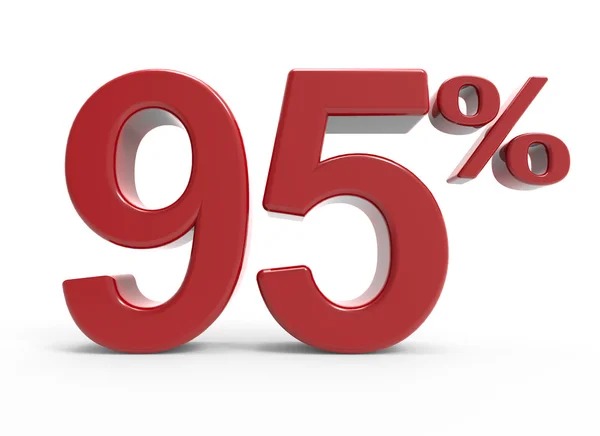
Organic certification is one of the oldest and most trusted food badges. In the European Union and Japan, the rules are remarkably similar: a product must contain at least 95% organic agricultural ingredients by weight to carry the official organic logo. That number isnʼt a rough guideline; it is a hard, binary line. Either a product crosses it, or it cannot use the logo at all. For TilliT, verifying an organic claim starts with a straightforward question — does the ingredient list, stripped of water and salt, cross that 95% threshold? — but the answer requires a far more delicate investigation.
| Criterion | EU Organic (Regulation 2018/848) | JAS Organic (Japan) |
|---|---|---|
| Minimum organic content | ≥95% of agricultural ingredients | ≥95% of agricultural ingredients (excluding water and salt) |
| Partial tiers | None — qualifies at 95% or it doesnʼt | No partial tiers; the logo is all-or-nothing |
| Non-organic ingredients allowed | Only those explicitly authorised under Annex V of Regulation 2018/848, a narrow list of hard-to-source items like certain colourings or lecithin that must be proven unavailable in organic form | A similar list of approved non-organic ingredients, allowing up to 5% total |
| Prohibited substances | GMOs, chemical synthetic pesticides, synthetic fertilizers | GMOs, chemical synthetic pesticides, synthetic fertilizers |
| Verification emphasis | Full documentation of organic certification for every ingredient; audits covering production, storage, and transport | Equivalent requirement: all organic ingredients must be certified by an accredited Japanese or internationally recognised body |
Important
The EU organic logo is not a sliding scale. There is no “made with organic ingredients” tier that can use the star-leaf emblem. A product with 94% organic content cannot carry the logo, even if the remaining 6% is completely natural. This all-or-nothing rule makes ingredient-level tracking indispensable.
- TilliT first parses the ingredient list using optical character recognition or direct digital feeds from manufacturers.
- Every ingredient is matched against a master database of certified organic suppliers and substances.
- If a non-organic ingredient appears, the system checks whether it appears on Annex V (for EU) or Japanʼs equivalent list and whether the processor has provided a valid justification for its use.
- Simultaneously, the tool screens for substances that are explicitly banned in organic production — most critically, genetically modified organisms, synthetic pesticides and synthetic fertiliser residues. Any hit triggers an automatic flag.
- The 95% arithmetic is performed by weight; TilliT can receive batch-level quantitative formulas, though most checks rely on the descending-order ingredient list and supplier declarations.
Because both systems demand that non-organic ingredients be used only when organic alternatives are unavailable, TilliT keeps a living compliance record. A manufacturer might show that organic rosemary extract was temporarily out of stock, but the system will ask for fresh evidence if the situation persists. Itʼs a verification process that doesnʼt just look at a single snapshot, but watches for drift over time.
How TilliT enforces the Non-GMO Project Standard
The Non-GMO Projectʼs butterfly seal is one of the fastest-growing voluntary certifications, appealing to shoppers who want to avoid genetically engineered ingredients. Unlike organic certification, which covers a broad spectrum of agricultural practices, Non-GMO Project Verified hones in on a single question: has any ingredient been produced through genetic modification, and if so, is it present above the allowed trace levels? The answer is a hard blocking check — a product that fails the thresholds cannot be verified. TilliT approaches this badge with the precision of a forensic accountant, scrutinising both the presence of high-risk crops and the residual GMO content that might slip in through complex global supply chains.
| Crop | Risk | GMO threshold |
|---|---|---|
| Corn (maize) | High — widely cultivated in GM varieties | ≤0.9% |
| Soy | High — majority of global soy is GM | ≤0.9% |
| Canola (rapeseed) | High | ≤0.9% |
| Sugar beets | High — nearly all US sugar beets are GM | ≤0.9% |
| Cottonseed | High | ≤0.9% |
| Alfalfa | High — GM varieties approved | ≤0.9% |
| Papaya | High — GM Rainbow papaya common | ≤0.9% |
| Zucchini / Yellow summer squash | Very high scrutiny | ≤0.9% |
| Sensitive products (e.g., baby food) | Very high scrutiny | ≤0.02% |
Hard Block
There is no wiggle room. If a tested sample shows 0.95% GMO presence in a high-risk ingredient — exceeding the 0.9% threshold by a decimal — the product cannot bear the Non-GMO Project Verified seal. This is a drop-dead rule, forcing manufacturers to maintain rigorous segregation and testing throughout the supply chain.
TilliTʼs verification engine begins by scanning the ingredient list for any of the high-risk crops, in any form: whole grain flour, isolated protein, starch, syrup, lecithin or oil. Even ingredients that sound innocuous — like “vegetable oil” or “natural flavours” — are cross-referenced against a database of possible GM origins. The platform does not rely on ingredient names alone; it demands supplier documentation proving that the crop was cultivated from non-GM seed and that preventative controls avoided cross-pollination.
For each flagged ingredient, TilliT expects a current Certificate of Analysis or a non-GMO supplier affidavit. The system calculates the cumulative GMO risk across the product, using worst-case scenarios when data is missing. If any high-risk ingredient remains unverified, the product is marked non-compliant. The tighter 0.02% threshold for sensitive products, such as infant formula, triggers an even more demanding review — often requiring finished-product testing because even minute traces from shared equipment can be disqualifying.
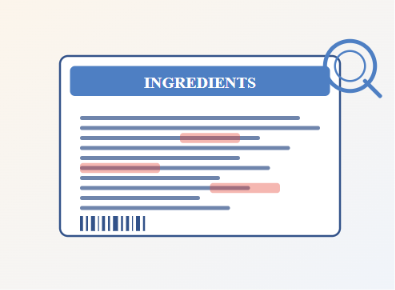
- Extract every ingredient from the product label and any supporting specification sheets.
- Identify high-risk inputs using the crop list above, plus any derivatives that could have a GM source.
- Request and validate supplier documentation: seed certificates, non-GMO project participation records or third-party PCR test results.
- Compare reported GMO levels against the applicable threshold (0.9% or 0.02%).
- Flag any gap — missing test, ambiguous origin, or lab result above the limit — as a non-conformance.
- For sensitive products, mandate finished-product testing before verification can proceed.
The gluten-free certification battle
Gluten-free labels are a lifeline for millions of people with coeliac disease or gluten sensitivity. But not all gluten-free claims are equal. The FDA permits foods labelled “gluten-free” to contain up to 20 parts per million (ppm) of gluten — a level that most coeliac bodies consider safe. The Gluten-Free Certification Organization (GFCO), however, draws a stricter line: less than 10 ppm. That tighter threshold means a product must be tested with a more sensitive methodology and that even tiny amounts of accidental gluten — from a shared toaster line or a trace of wheat starch — can be the difference between certified and not. For TilliT, verifying a GFCO badge starts with an ingredient-level hunt for gluten and ends with a hard look at lab sheets.
| Standard | Maximum gluten allowed | Testing requirement |
|---|---|---|
| FDA “gluten-free” (USA) | <20 ppm | Ingredient-based screening plus occasional testing |
| GFCO Certified Gluten-Free | <10 ppm | Rigorous finished-product testing, plus annual audits |
| EU “gluten-free” (Codex) | <20 ppm | Finished-product testing required |
Fermented and Hydrolysed Exception
As of August 2020, the FDA requires that fermented or hydrolysed foods - think yogurt, cheese, beer, wine, sauerkraut and hydrolysed protiens - undergo finished-product testing for gluten, even if ingredients lists appear clean. The reason? Fermentation can break gluten proteins into frangments that strandard ingredient-level checks miss, making lab analysis the only reliable proof.
TilliTʼs system first screens the ingredient list for any gluten-containing grains or their derivatives: wheat, barley, rye and all their aliases — malt extract, brewerʼs yeast grown on barley, seitan, wheat dextrin and dozens more. The platform maintains a multilingual database that catches these ingredients whether they appear on an American, European, or Asian label. When an ingredient is flagged, the product is not automatically discarded; instead, TilliT insists on a certificate showing the gluten level in that ingredient sits below the 10 ppm ceiling. For composite ingredients like “spices” or “natural flavours,” the processor must provide a breakdown confirming no gluten-derived carriers.
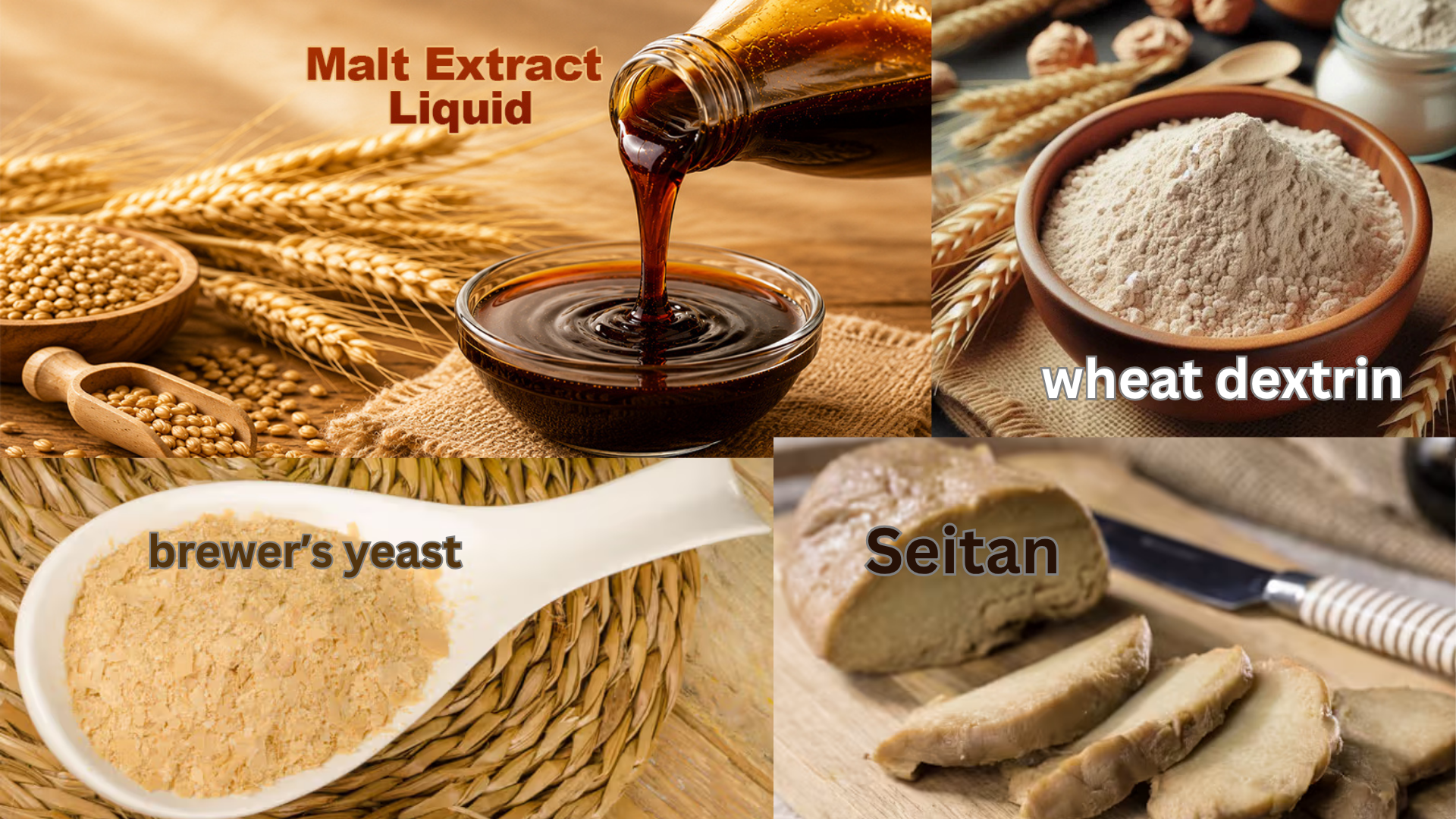
If the product falls into the fermented/hydrolysed category, the system triggers an additional requirement: a finished-product gluten test from an accredited lab, with results below 10 ppm. Even if every ingredient comes with a clean bill, a batch of sauerkraut or a bottle of gluten-removed beer wonʼt earn the GFCO badge in TilliTʼs view until that final test is in. This two-pronged approach — ingredient screening plus finished-product testing for the tricky products — closes a gap that earlier, paper-based audits often left open.
Verifying allergen-free claims with exact science
For someone with a food allergy, a label that says “free from” is not a preference; itʼs a medical shield. The Certified Free From (CFF) program, operated by the Food Allergy Research & Resource Program (FARRP) and other certifying bodies, verifies products against nine major allergens — milk, egg, fish, crustacean shellfish, tree nuts, peanuts, wheat, soy and sesame — using extremely sensitive detection thresholds. A product can carry a “free-from” badge only if every allergen is either absent or present below the VITAL (Voluntary Incidental Trace Allergen Labelling) 3.0 action levels. TilliT treats these numbers as non-negotiable, applying a pipeline that starts with a single glance at the mandatory label and then dives deep into the hidden corners of ingredient sourcing.
| Allergen | Threshold (ppm of protein) | Notes |
|---|---|---|
| Peanuts | 0.1 | Extremely sensitive; shared equipment risk is high |
| Tree nuts (e.g. almond, hazelnut) | 0.1 | Each nut species is treated individually |
| Fish | 0.1 | Covers all fin fish |
| Egg | 0.5 | White and yolk proteins considered |
| Soy | 1.0 | Soy lecithin may be refined, but risk remains if not pure |
| Crustacean shellfish | 1.0 | Shrimp, crab, lobster |
| Milk | 2.5 | Includes lactose-free but milk-protein-containing products |
| Sesame | 2.5 | Must be declared even in spice blends and natural flavours per FASTER Act (US, effective Jan 2023) |
| Wheat | 10.0 | Higher threshold, but gluten-free wheat-based ingredients still pose risk |
Immediate Disqualifier
If a product carries a mandatory "Contains: [allergen]" statement on the label - for example, "Contains: milk, soy" - it can never be certified as free-from that allergen. TilliT's verification stops the moment such a declaration is detected; no further testing is needed. This black-and-white rule ensures that the badges is never diluted by legalistic imterpretation.
Behind the scenes, TilliTʼs platform reads every character on the label. Optical character recognition extracts the ingredient list and the “Contains” or “May contain” statements. The system instantly flags any of the nine allergens in any form — “casein,” “albumin,” “shrimp extract,” “soybean lecithin,” “sesame seeds” and all their international synonyms. But the real challenge lies in hidden allergens: sesame in “spice blends” or “natural flavours,” wheat gluten in “caramel colouring,” milk protein in “grilled chicken breast,” or fish sauce in “Worcestershire sauce.” To catch those, TilliT cross-references every vague ingredient with supplier-provided breakdowns and allergen control plans.
Sesame presents a special case. Since the FASTER Act took effect in the United States on January 1, 2023, sesame must be declared even when it is part of another flavouring or spice mix — no more hiding under “natural flavour.” TilliTʼs verification engine checks that any time a spice blend or natural flavour appears, the supplier has explicitly confirmed the absence of sesame. If the documentation is absent or ambiguous, the product is marked as non-compliant for the allergen-free badge.
Finally, TilliT enforces the VITAL thresholds by requiring quantitative test results — ELISA or PCR-based — for each allergen that could plausibly be present due to shared facilities. If any result exceeds the per-allergen limit, the badge is denied. Even a reading of 0.15 ppm for peanut would breach the 0.1 ppm ceiling. This data-driven gatekeeping transforms a well-intended label claim into a promise that can be numerically verified, batch after batch.
Conclusion
Food badges might look like colourful stickers, but they carry the weight of health, belief, and trust. When a badge says “organic,” a parent expects that no synthetic pesticide touched the oats in their childʼs breakfast. When it says “Non-GMO Project Verified,” a shopper trusts that the canola oil wasnʼt engineered in a lab. When it says “gluten-free” or “free from top allergens,” diners with medical conditions are betting their well-being on that promise. TilliTʼs ingredient-level verification doesnʼt just audit compliance; it stands behind every one of those bets. By turning ingredient lists into searchable, rule-checked data — and by refusing to accept a badge at face value — the platform builds a safety net that didnʼt exist a decade ago. Itʼs a quiet revolution in food transparency, one ingredient line at a time, and it means that the next badge a consumer sees on a shelf may be the most honest one yet.